
Should I Sell My Dallas-Fort Worth Home in 2026 or Wait?
If you own a home in Dallas-Fort Worth, you may be wondering:
Should I sell my DFW home in 2026, or would I be better off waiting?
It is one of the most important questions a homeowner can ask, especially after several years of dramatic changes in North Texas real estate.
The Dallas-Fort Worth housing market in 2026 looks very different from the extremely competitive market experienced earlier this decade. Buyers generally have more homes to choose from, properties are taking longer to sell, and sellers need to be much more strategic about pricing.
That doesn't necessarily mean it's a bad time to sell.
For homeowners with significant equity, a desirable property and a strong reason to move, 2026 could still be an excellent time to sell a home in Dallas-Fort Worth.
The key is understanding your local market rather than making a decision based on national housing headlines.
What Is Happening in the Dallas-Fort Worth Housing Market in 2026?
The Dallas-Fort Worth real estate market has moved toward more balanced conditions.
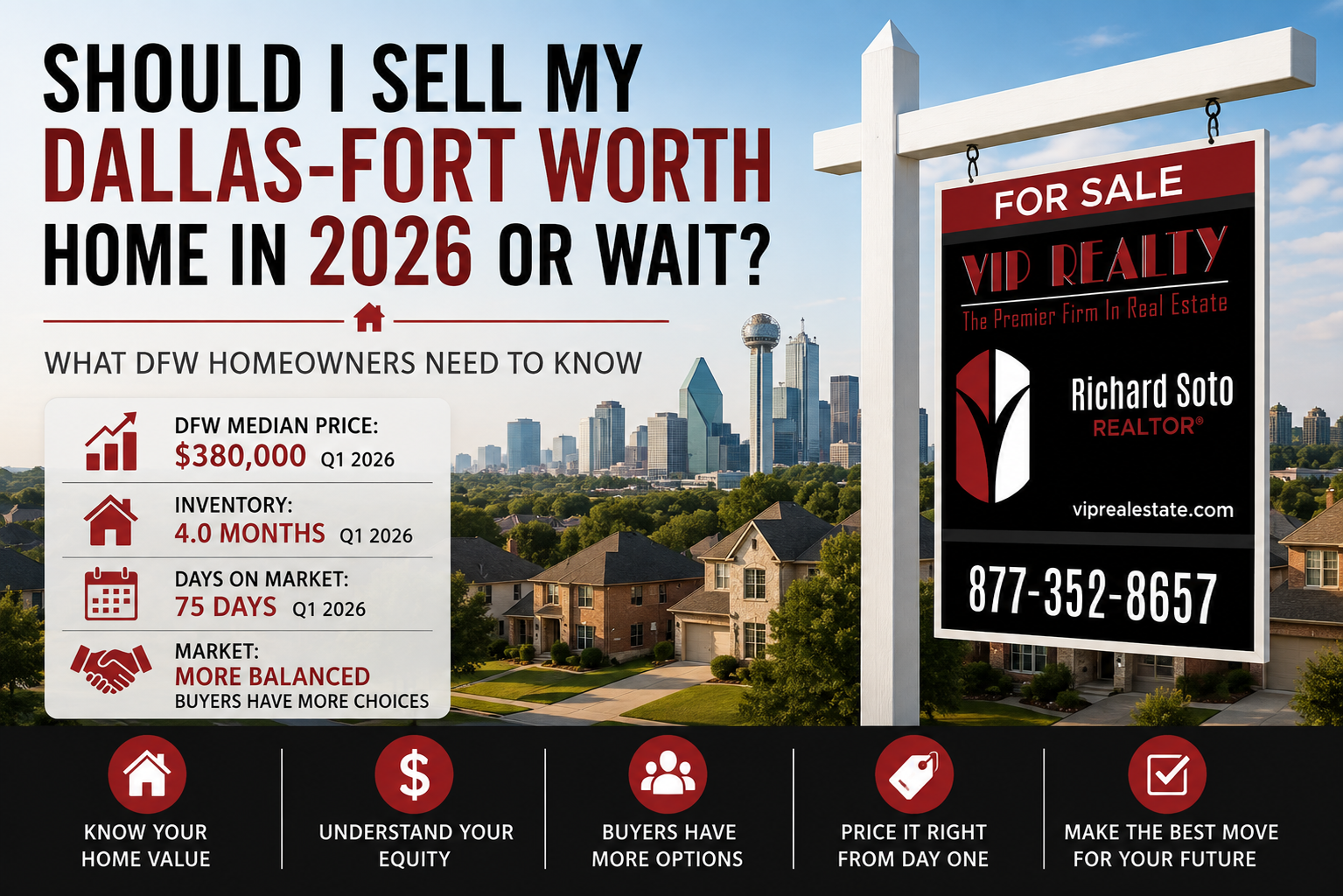
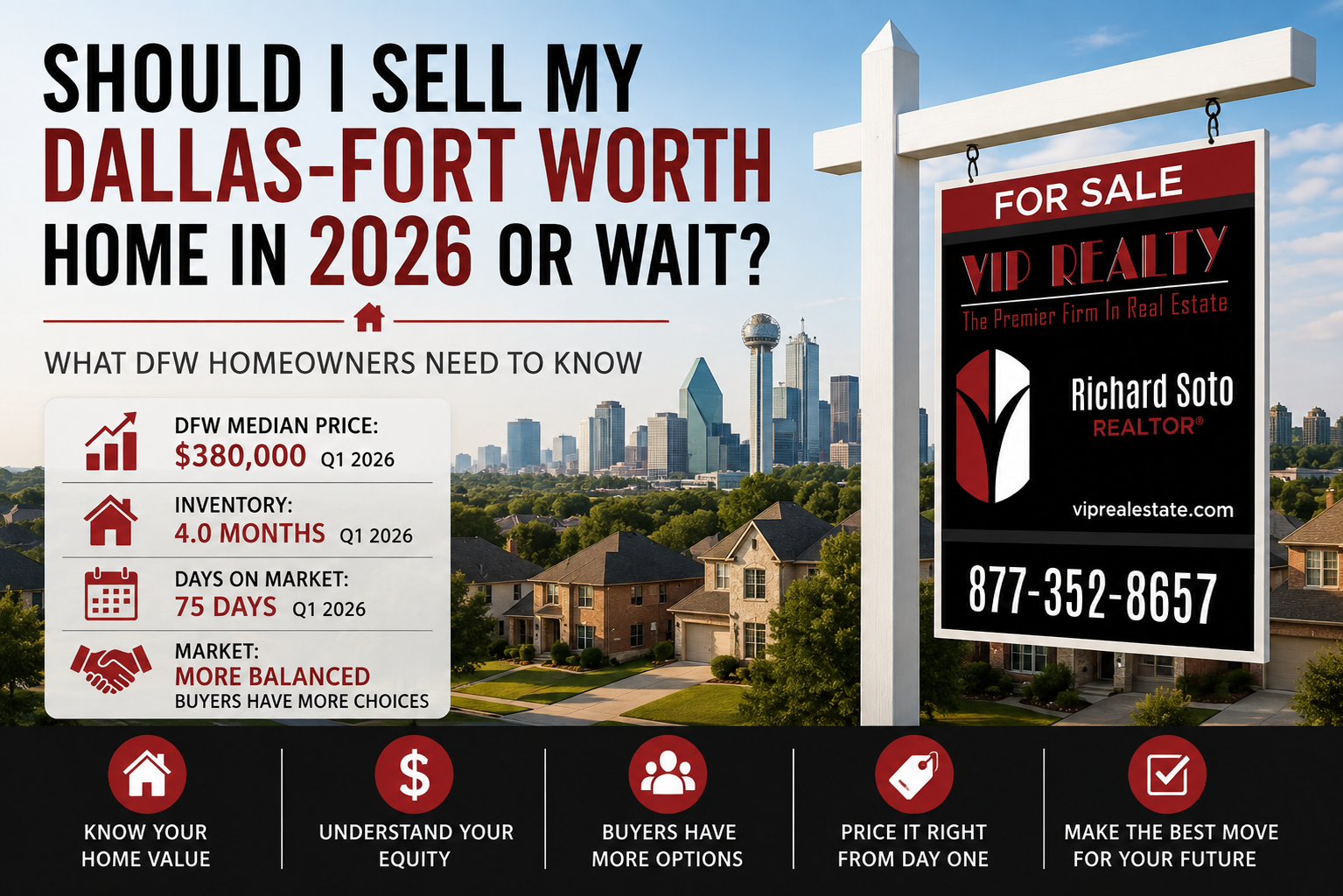
During the first quarter of 2026, the median sales price for the Dallas-Fort Worth-Arlington metro area was approximately $380,000, representing a 2.8% decrease compared with the same quarter the previous year.
DFW recorded approximately 19,310 closed sales during the quarter, while the average property spent approximately 75 days on the market.
Inventory stood at approximately 4 months, compared with 3.9 months during the same period in 2025.
These numbers point toward a more balanced marketplace where neither buyers nor sellers automatically control every transaction.
For sellers, this means one thing:
Your pricing, condition and marketing strategy matter significantly more than they did during the hottest years of the DFW housing boom.
Is 2026 a Good Time to Sell a House in Dallas-Fort Worth?
For many homeowners, yes, 2026 can still be a good time to sell a home in Dallas-Fort Worth.
However, the answer depends much more on your individual circumstances than on whether DFW home prices rise or fall a few percentage points.
You should consider:
- How much equity you have
- Your remaining mortgage balance
- Your current mortgage interest rate
- Your home's estimated market value
- How much competition exists in your neighborhood
- Where you plan to move next
- Whether you need to purchase another home
- Your financial and lifestyle goals
A homeowner who purchased a North Texas property ten years ago may be in a completely different financial position than someone who purchased near the height of the recent market.
That's why the question shouldn't simply be, "Is this a good market?"
A better question is:
"Does selling my DFW home in 2026 put me in a better financial or lifestyle position?"
1. Find Out How Much Your DFW Home Is Actually Worth
Before deciding whether to sell or wait, start by determining your property's realistic market value.
Online home-value estimates can be useful as a starting point, but they don't always account for the details that influence what buyers are willing to pay.
A proper home-value analysis should consider:
- Recent comparable sales
- Current competing homes for sale
- Pending sales
- Neighborhood inventory
- Price per square foot
- Lot size
- Property condition
- Renovations and upgrades
- School district
- Location within the neighborhood
- Current buyer demand
This is particularly important in Dallas-Fort Worth because there is no single "DFW housing market."
Real estate conditions in Dallas can differ from Fort Worth. Frisco can behave differently from Plano. Prosper, McKinney, Southlake, Arlington, Irving, Las Colinas and other communities can each have their own inventory levels, buyer demand and pricing trends.
Even two subdivisions located a few miles apart can experience different market conditions.
2. Calculate How Much Equity You Have
Home equity should play a major role in your decision.
Your approximate gross equity can be calculated by subtracting your remaining mortgage balance from your home's estimated market value.
For example:
Estimated home value: $600,000
Remaining mortgage: $275,000
Approximate gross equity: $325,000
That doesn't mean you would receive $325,000 at closing. You still need to account for applicable selling expenses, mortgage payoff amounts, taxes, repairs, concessions and other potential closing costs.
But understanding your approximate equity gives you a much clearer picture of your options.
Longtime DFW homeowners may have accumulated significant equity after years of appreciation.
That equity could potentially be used to purchase another property, downsize, relocate, invest, reduce debt or help fund retirement.
3. Buyers Have More Choices in 2026
One of the biggest changes in today's DFW real estate market is increased competition among sellers.
During the first quarter of 2026, Dallas-Fort Worth had approximately four months of housing inventory.
That's significantly different from periods when buyers had very few properties to choose from and were frequently competing against multiple offers.
More inventory means buyers can compare your home against other properties.
They may compare:
- Price
- Condition
- Upgrades
- Location
- Lot size
- School district
- Seller concessions
- Days on market
This makes it especially important to position your home correctly from the beginning.
4. Overpricing Your DFW Home Can Cost You
One of the biggest mistakes a seller can make in 2026 is pricing a home based on what properties were selling for during a different market cycle.
The market determines value—not what a neighbor received three years ago, what you spent remodeling the kitchen or how much money you need to purchase your next property.
Buyers have access to enormous amounts of real estate information.
If similar homes are listed for $500,000 and yours enters the market at $575,000 without a clear reason for the premium, buyers may simply skip it.
The danger isn't only that the home doesn't sell.
As days on market accumulate, buyers may begin wondering why nobody else has purchased the property.
Eventually, the seller may need to reduce the price anyway.
Correct pricing from day one can be one of the most powerful marketing strategies available to a DFW home seller.
5. Should You Wait for DFW Home Prices to Increase?
Some homeowners considering selling in 2026 are thinking about waiting until 2027 or later in hopes that home prices increase.
That strategy could work—but there are no guarantees.
Real estate prices are influenced by numerous factors, including:
- Mortgage rates
- Employment
- Population growth
- New construction
- Housing inventory
- Consumer confidence
- Inflation
- Local economic conditions
Even if your home appreciates, the property you plan to purchase may also increase in price.
Trying to perfectly time the housing market can therefore be extremely difficult.
If selling today accomplishes an important financial or lifestyle goal, waiting solely because your property might be worth more next year isn't necessarily the best strategy.
6. Your Low Mortgage Rate May Be a Reason to Wait
There is one major reason some homeowners are reluctant to sell: their existing mortgage.
If you refinanced or purchased when mortgage rates were exceptionally low, replacing that loan with today's financing could significantly increase your monthly housing expense.
Suppose you're currently carrying a mortgage with a rate near 3%.
Selling that home and purchasing another property with a substantially higher mortgage rate could increase your monthly payment even if the new home has a similar price.
Before selling, calculate what your next housing payment could realistically look like.
If your current home still meets your needs and your existing financing is extremely favorable, waiting may make financial sense.
7. Should You Sell Before Buying Your Next DFW Home?
If you're staying in Dallas-Fort Worth, you will need to decide whether to sell your current property before purchasing another home.
Selling First
Selling first gives you certainty about how much money you'll have available for your next purchase.
It can also make your next offer cleaner because it isn't dependent on selling your existing property.
The downside is that you may need temporary housing between transactions.
Buying First
Buying first can make moving more convenient because you already have your next home.
However, carrying two mortgages creates additional financial exposure.
Some homeowners may consider strategies such as:
- Seller leasebacks
- Contingent offers
- Bridge financing
- Home equity financing
- Coordinating simultaneous closings
The right approach depends on your finances and the competitiveness of the particular DFW markets where you're selling and buying.
8. Should You Sell Your DFW Home or Rent It Out?
Dallas-Fort Worth has experienced substantial population growth over the years, which may cause some homeowners to consider keeping their property as a rental instead of selling it.
That can be a smart strategy in the right situation.
Keeping the property may make sense if:
- Market rent comfortably covers your expenses
- You have a low mortgage rate
- You want to continue owning DFW real estate
- You have adequate financial reserves
- You are comfortable managing a rental
Selling may make more sense if:
- You need the equity for your next purchase
- You don't want to become a landlord
- Rental income doesn't justify keeping the property
- The home needs substantial future maintenance
- You want to invest your equity elsewhere
When calculating potential rental returns, remember to include more than the mortgage.
Consider property taxes, insurance, HOA fees, maintenance, repairs, vacancy, property management and future capital expenses.
9. Should You Remodel Before Selling?
You don't necessarily need to spend tens of thousands of dollars remodeling your home before putting it on the market.
In many cases, smaller improvements provide a better return.
Before listing, consider:
- Fresh paint
- Professional cleaning
- Decluttering
- Landscaping
- Pressure washing
- Replacing outdated fixtures
- Improving lighting
- Minor repairs
- Staging
- Professional real estate photography
North Texas buyers often compare resale homes with new construction, particularly in rapidly growing suburban markets.
That makes presentation important.
However, don't automatically spend $50,000 remodeling a kitchen because you assume you'll receive $75,000 more when you sell.
Compare the expected selling price before and after improvements before making a major investment.
10. New Construction Is Competition for Some DFW Sellers
Dallas-Fort Worth continues to have significant new-home construction, particularly in growing suburban areas.
That matters because builders may offer incentives that an individual homeowner cannot always duplicate.
Depending on market conditions, new-home builders may offer financing incentives, closing-cost assistance, upgrades or other promotions.
If you're selling in an area with substantial new construction, your agent should evaluate both resale properties and nearby new construction when developing your pricing and marketing strategy.
Your resale home may still have important advantages, including an established neighborhood, mature landscaping, completed amenities, a larger lot or a more convenient location.
The key is understanding how to position those advantages.
11. Luxury DFW Homes Require a Different Strategy
Dallas-Fort Worth's luxury housing market remains significant.
From November 2024 through October 2025, DFW accounted for approximately 38% of all Texas homes sold for $1 million or more. There were 5,485 million-dollar-plus sales in the metro area representing approximately $9.7 billion in sales volume.
The median closing price among DFW homes selling for at least $1 million was approximately $1.42 million.
However, million-dollar DFW properties closed at approximately 93% of their original listing prices during that period.
That demonstrates why luxury sellers need to pay close attention to initial pricing.
Luxury homes have a smaller potential buyer pool, and pricing errors can become expensive.
12. What Is the Best Time of Year to Sell a House in DFW?
Spring and early summer traditionally receive significant attention from Dallas-Fort Worth sellers.
Families may prefer to move before a new school year, daylight hours are longer, landscaping generally presents well and more buyers may be actively searching.
However, DFW homes sell throughout the year.
The best time to sell isn't necessarily determined by the calendar.
Sometimes entering the market when fewer competing homes are available can give your property greater visibility.
A better formula is:
Buyer demand + available inventory + competing listings + your personal timeline = your best time to sell.
Signs It May Be Time to Sell Your Dallas-Fort Worth Home
Selling in 2026 may make sense if:
- You have substantial equity
- You need a larger home
- You want to downsize
- You're relocating
- Your current property no longer fits your lifestyle
- You're approaching retirement
- You inherited a property
- You own an investment property you no longer want
- You want to move closer to family
- You need your equity for another investment or purchase
- Maintaining the home is becoming expensive
When Could Waiting Make More Sense?
Waiting could be worth considering if:
- You have an exceptionally low mortgage rate
- Your current home still meets your needs
- You recently purchased the property
- You don't have enough equity after estimated selling costs
- Your next housing payment would be substantially higher
- Your neighborhood currently has unusually high inventory
- You aren't financially or personally ready to move
The decision should ultimately be based on your specific financial situation rather than predictions about whether DFW home prices will rise or fall next year.
Dallas vs. Fort Worth: Does Location Change the Answer?
Absolutely.
Dallas-Fort Worth is one of America's largest metropolitan areas, so broad market statistics only tell part of the story.
A homeowner considering selling in Preston Hollow could face very different conditions than someone selling in North Fort Worth.
The same applies to Frisco, Plano, McKinney, Prosper, Southlake, Colleyville, Arlington, Irving, Las Colinas, Flower Mound and dozens of other North Texas communities.
That's why homeowners should look at their specific neighborhood, property type and price range before deciding whether now is a good time to sell.
Frequently Asked Questions About Selling a DFW Home in 2026
Is 2026 a good time to sell a house in Dallas?
For some homeowners, yes. Dallas-Fort Worth continues to record significant home sales, but sellers face more competition than during the extremely tight housing markets earlier this decade. Your equity, neighborhood inventory, home condition and asking price should all influence your decision.
Are Dallas-Fort Worth home prices falling?
The DFW median sales price was approximately $380,000 during the first quarter of 2026, down about 2.8% compared with the same period in 2025. However, price trends vary substantially between individual cities, neighborhoods and price ranges.
How long does it take to sell a house in Dallas-Fort Worth?
During Q1 2026, DFW homes averaged approximately 75 days on the market before going under contract, with another 32 days to close. Individual properties can sell much faster or slower depending on price, location, condition and buyer demand.
Is Dallas-Fort Worth a buyer's or seller's market in 2026?
DFW is more balanced than it was during the highly competitive pandemic-era housing market. Approximately four months of inventory were available during Q1 2026, giving buyers more choices while still allowing correctly priced sellers to compete effectively.
Should I sell my DFW home now or wait until 2027?
Don't base your decision solely on predictions about future home prices. Consider your equity, mortgage rate, reason for moving, estimated proceeds and cost of your next home. If selling accomplishes an important financial or lifestyle goal, waiting for a potentially higher price may not necessarily produce a better outcome.
What is the biggest mistake DFW home sellers make?
Overpricing is one of the most damaging mistakes in a market where buyers have more choices. Pricing correctly from the beginning can help attract serious buyers and prevent unnecessary days on market and repeated price reductions.
Thinking About Selling Your Dallas-Fort Worth Home?
The question isn't simply whether 2026 is a good year to sell.
The more important question is whether 2026 is the right year for you to sell.
Before making a decision, find out:
- What is your DFW home worth today?
- How much equity do you have?
- How many similar homes are competing with yours?
- How quickly are homes selling in your neighborhood?
- What could you realistically walk away with after the sale?
VIP Realty helps Dallas-Fort Worth homeowners understand their local real estate market and develop a strategy based on their individual property and goals.
Whether you're considering selling a home in Dallas, Fort Worth, Frisco, Plano, McKinney, Prosper, Irving, Arlington, Southlake or another DFW community, understanding your property's actual market position is the first step.
Thinking about selling your DFW home in 2026? Contact VIP Realty for a complimentary home-value and market analysis and find out what your property could sell for in today's market.
Real estate markets can change quickly, and conditions vary by neighborhood and property. Market statistics referenced in this article are based on Texas REALTORS® and Texas Real Estate Research Center data. This article is for general informational purposes and should not be considered financial, tax or legal advice.
Posted by VIP Realty onEnjoy this blog post? Click here to subscribe for updates
Leave A Comment